

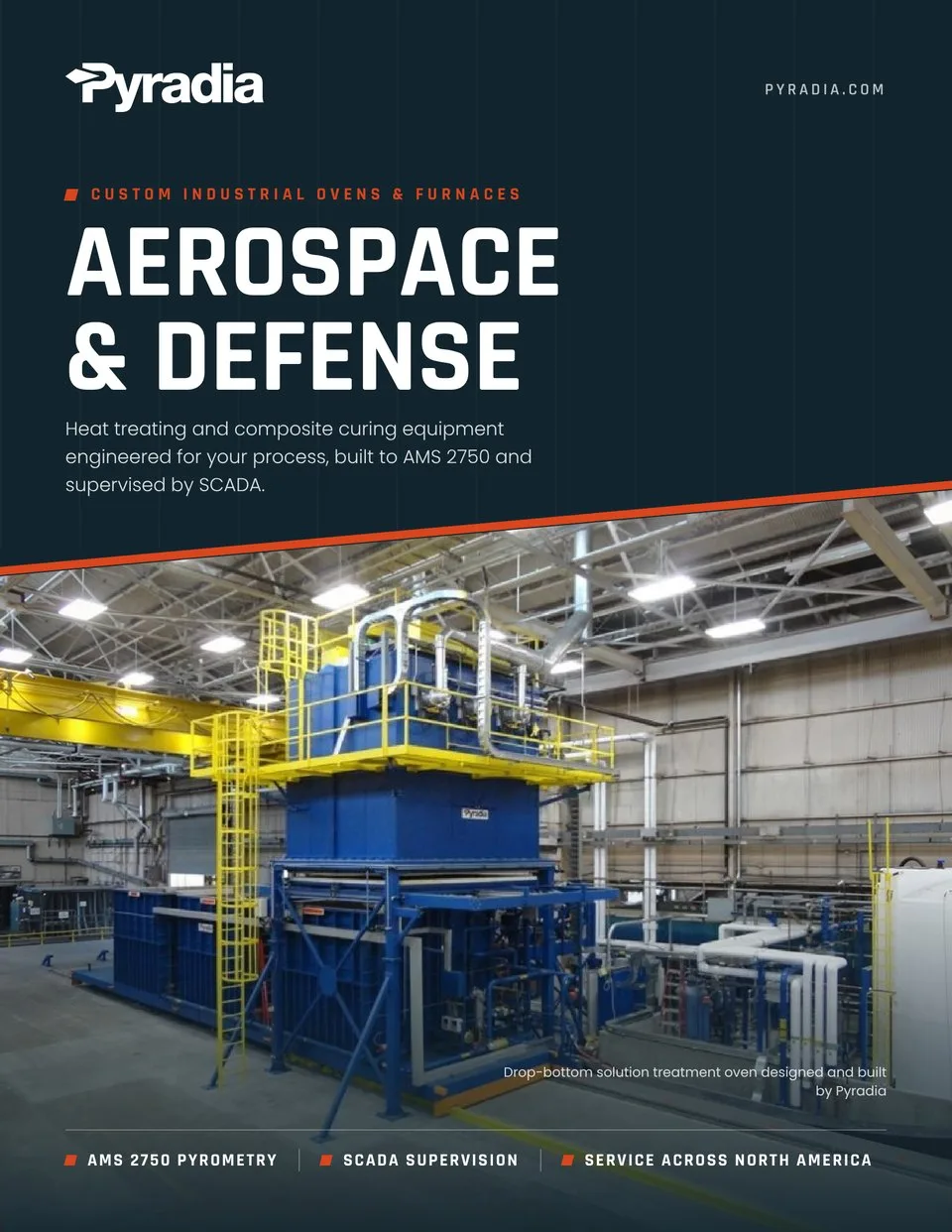
Seven chapters to plan your project
From Pyradia’s history to the technical highlights of our range, everything you need to start an aerospace or defense oven project.
-
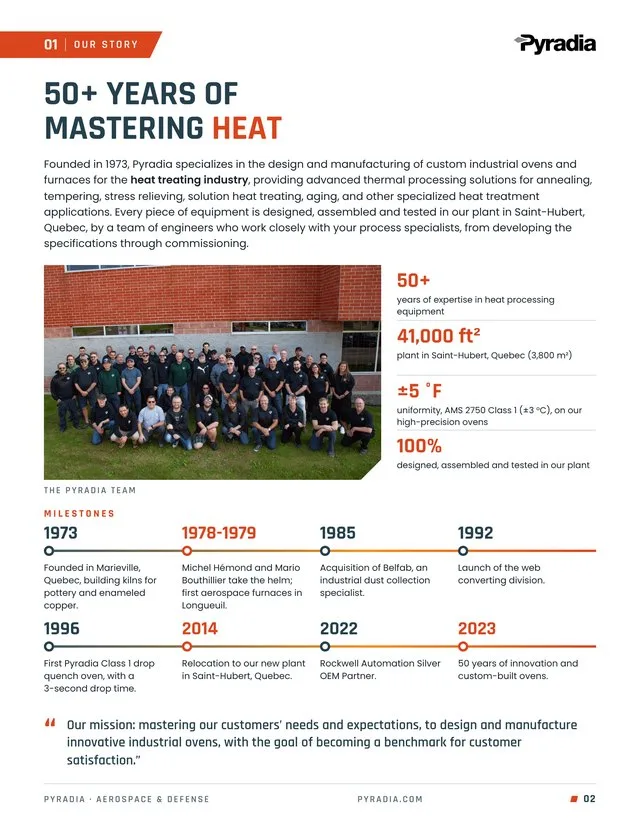
01Our story
50+ years of custom ovens, our milestones and our mission.
-
02The market
North America 2026: budgets, production ramp-ups and what they mean for your plant.
-
03Aerospace
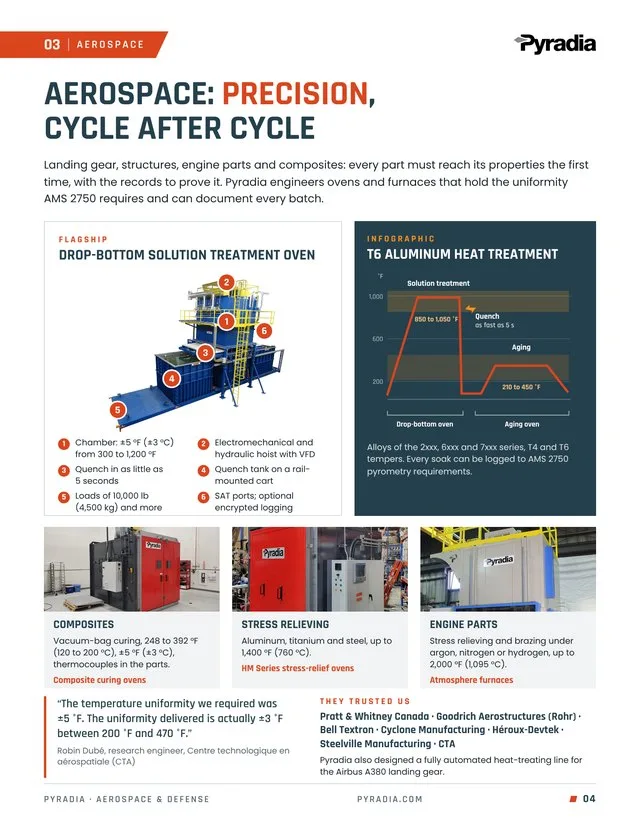
The annotated drop-bottom oven, the T6 cycle and our solutions for composites and engine parts.
-
04Defense
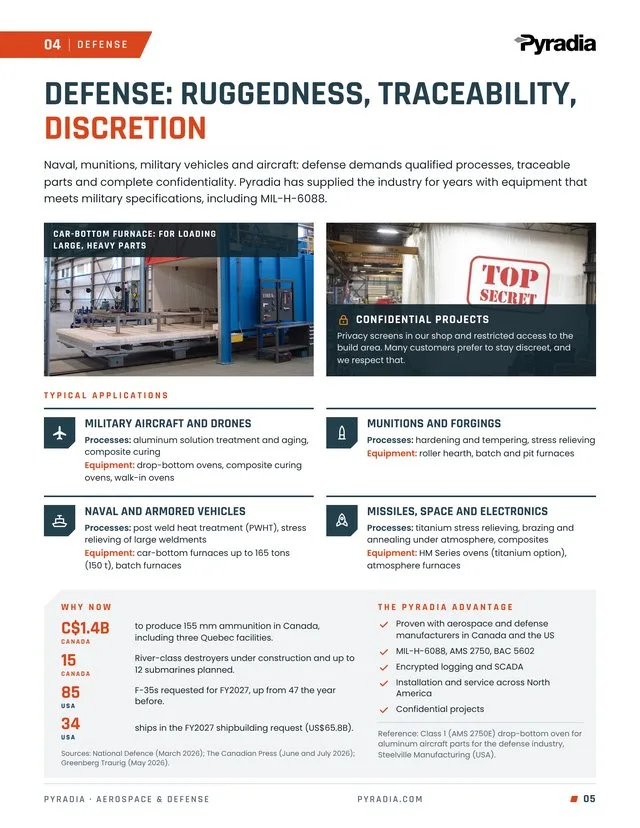
Typical applications, confidential projects and the numbers that make now the time to act.
-
05Custom-engineered
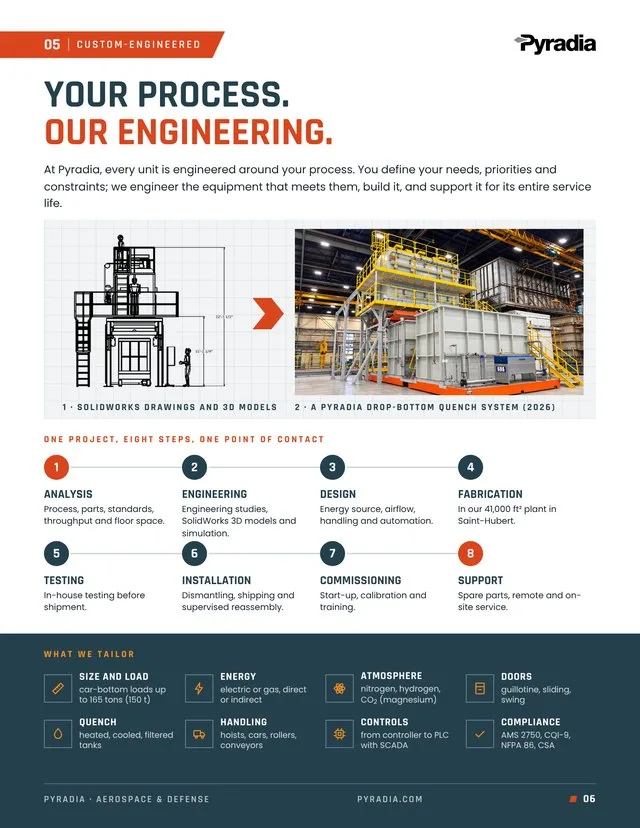
From SolidWorks drawings to an installed oven: eight steps, one point of contact.
-
06SCADA & compliance
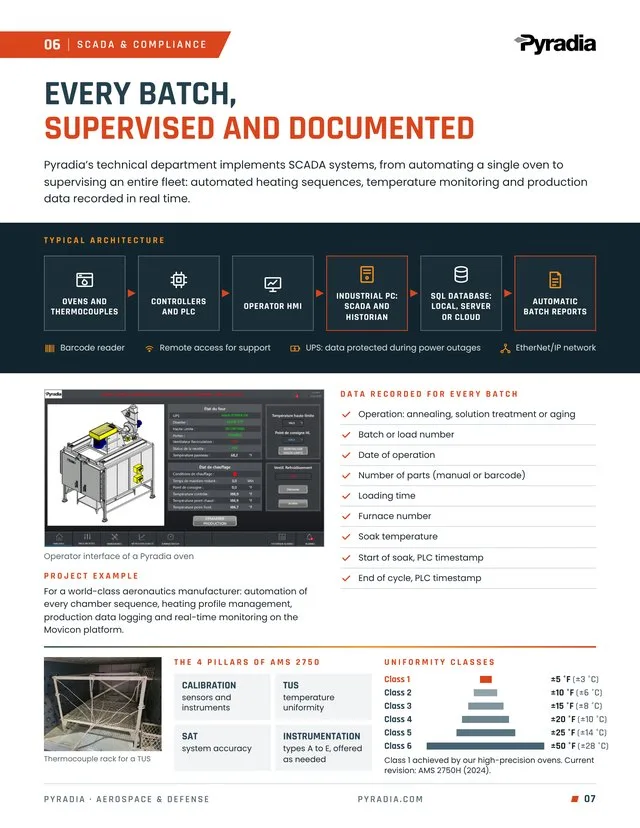
Typical architecture, data recorded for every batch and AMS 2750 uniformity classes.
-
07Technical highlights
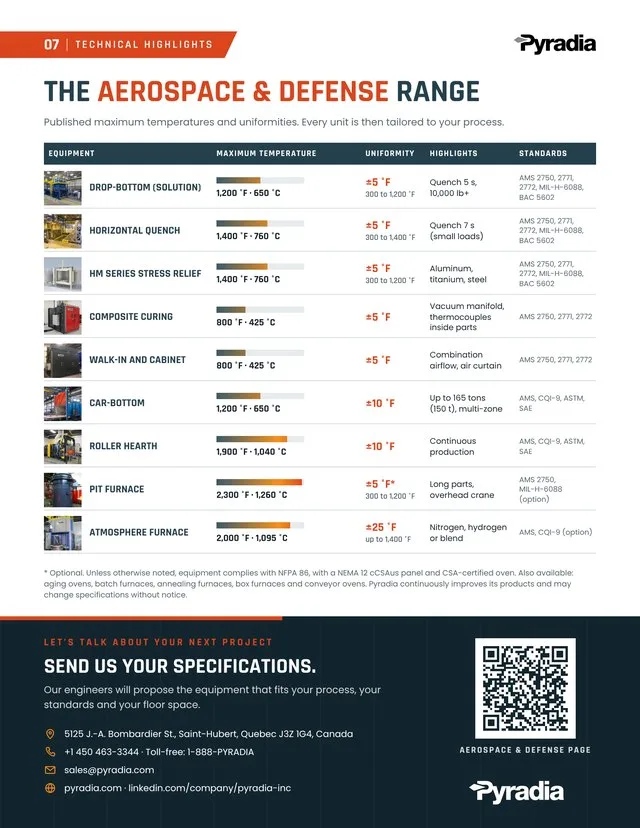
Maximum temperatures, uniformities and standards for our nine flagship units.
-
The whole brochure, one click
8-page PDF (7 MB) to read on screen or print for your team.
50+
years of expertise in heat processing equipment
41,000 ft²
plant in Saint-Hubert, Quebec (3,800 m²)
±5 °F
uniformity, AMS 2750 Class 1 (±3 °C), on our high-precision ovens
100%
designed, assembled and tested in our plant
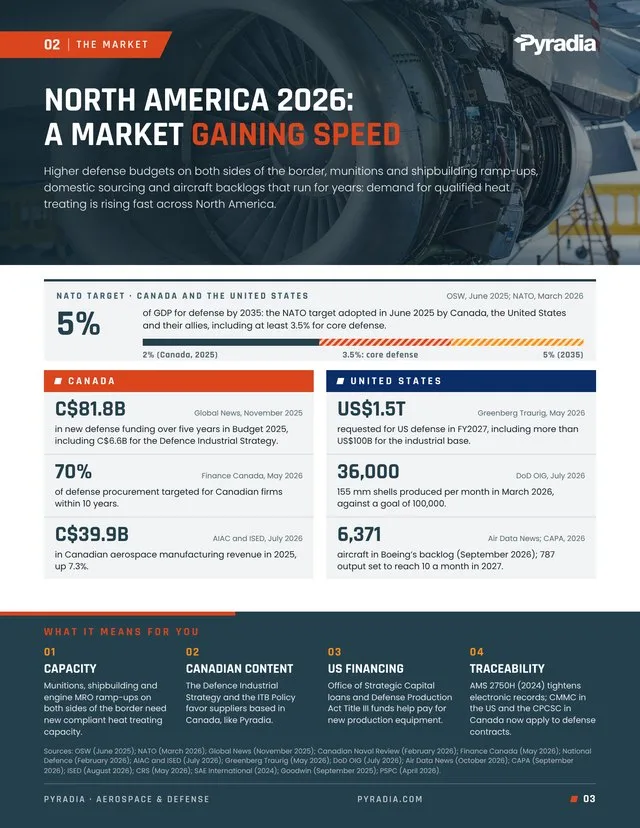
North America 2026: a market gaining speed
Higher defense budgets on both sides of the border, munitions and shipbuilding ramp-ups and aircraft backlogs that run for years: demand for qualified heat treating is rising fast.
The full analysis, what it means for your plant and every source are on page 3 of the brochure.
Read the analysis in the brochureRamping up production?
Plan the heat treating capacity you will need now. Our specialists help you size the right equipment.
Plan my project5%
NATO · Canada and the United States
of GDP for defense by 2035, including at least 3.5% for core defense.
OSW, June 2025
Canada
C$81.8B
in new defense funding over five years (Budget 2025), including C$6.6B for the Defence Industrial Strategy.
Global News, November 2025
United States
US$1.5T
requested for US defense in FY2027, including more than US$100B for the industrial base.
Greenberg Traurig, May 2026
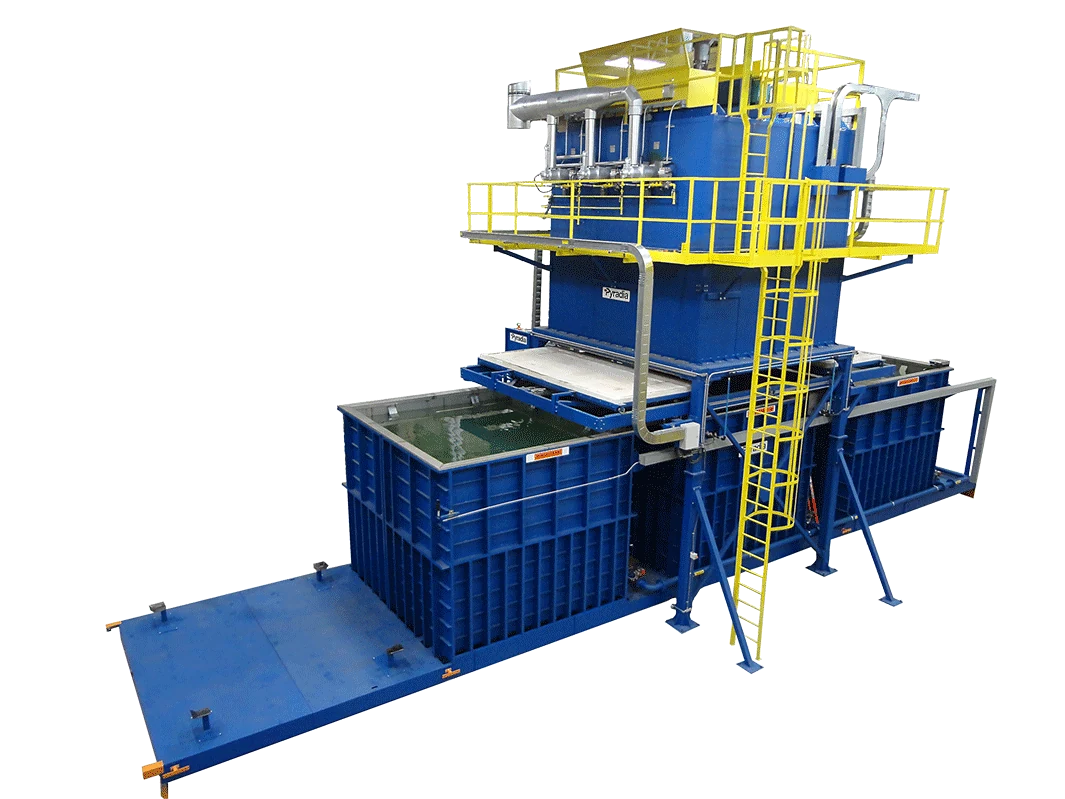
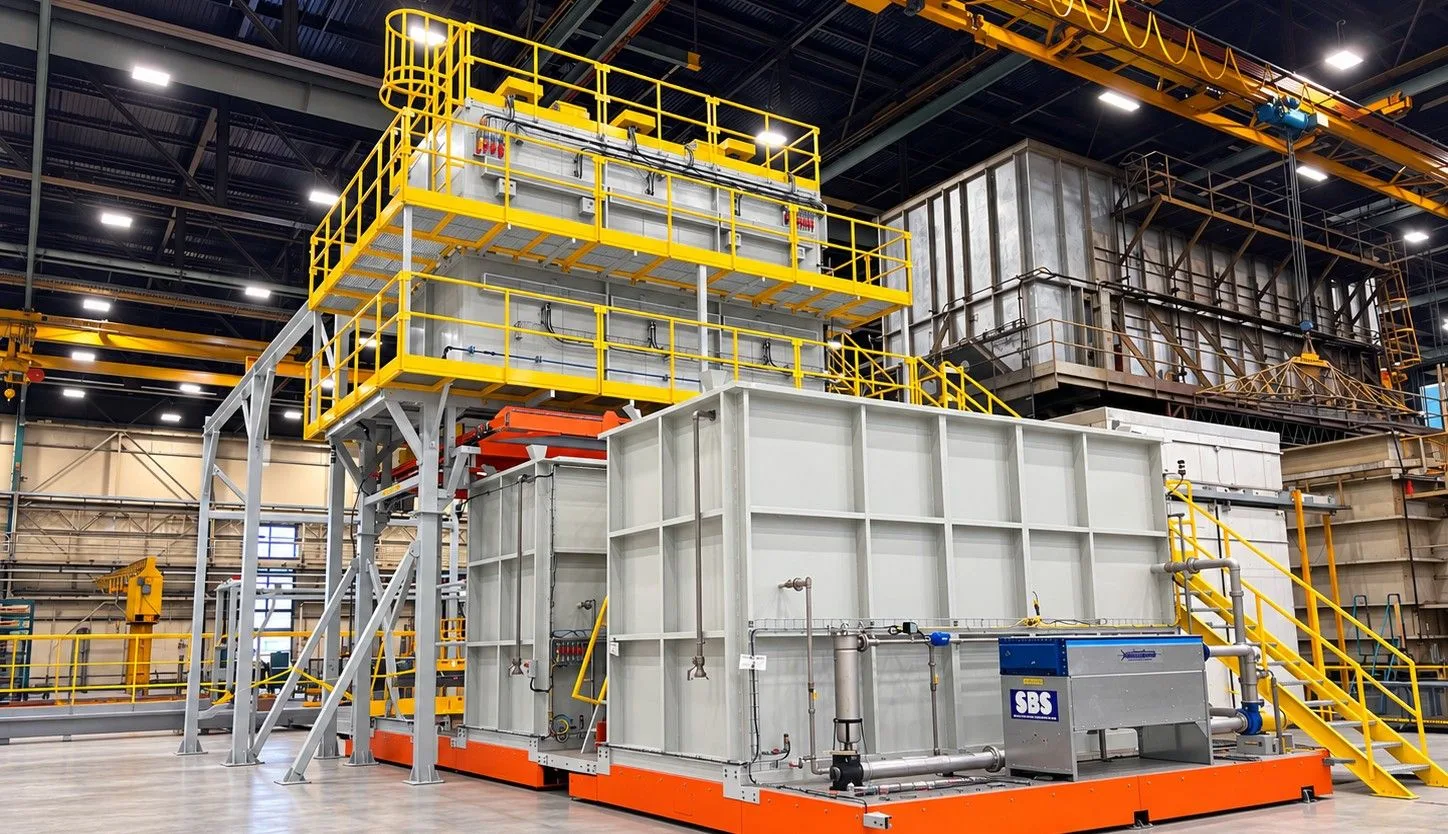
Drop-bottom solution treatment oven
For solution treating 2xxx, 6xxx and 7xxx series aerospace aluminum: the load drops from the oven into the quench tank in seconds, and every soak can be logged to AMS 2750 pyrometry requirements.
- 1Chamber: ±5 °F (±3 °C) from 300 to 1,200 °F
- 2Electromechanical and hydraulic hoist with VFD
- 3Quench in as little as 5 seconds
- 4Quench tank on a rail-mounted cart
- 5Loads of 10,000 lb (4,500 kg) and more
- 6SAT ports; optional encrypted logging
A range for every process
Published maximum temperatures and uniformities. Every unit is then tailored to your process.
-
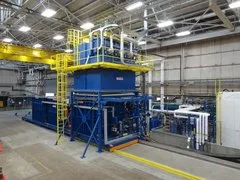
Drop-bottom (solution)
1,200 °F · 650 °C
±5 °F300 to 1,200 °F
Quench 5 s, 10,000 lb+
-
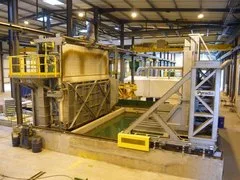
Horizontal quench
1,400 °F · 760 °C
±5 °F300 to 1,400 °F
Quench 7 s (small loads)
-
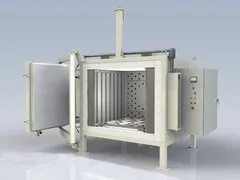
HM Series stress relief
1,400 °F · 760 °C
±5 °F300 to 1,200 °F
Aluminum, titanium, steel
-
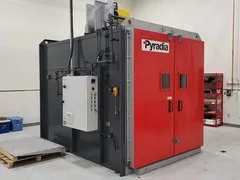
Composite curing
800 °F · 425 °C
±5 °F
Vacuum manifold, thermocouples inside parts
-
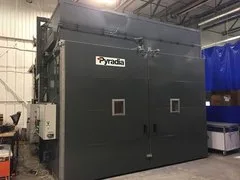
Walk-in and cabinet
800 °F · 425 °C
±5 °F
Combination airflow, air curtain
-
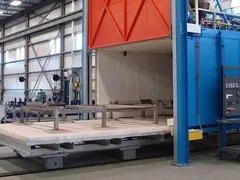
Car-bottom
1,200 °F · 650 °C
±10 °F
Up to 165 tons (150 t), multi-zone
-
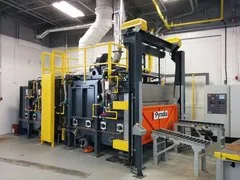
Roller hearth
1,900 °F · 1,040 °C
±10 °F
Continuous production
-
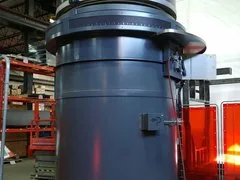
Pit furnace
2,300 °F · 1,260 °C
±5 °F*300 to 1,200 °F
Long parts, overhead crane
-
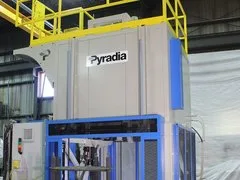
Atmosphere furnace
2,000 °F · 1,095 °C
±25 °Fup to 1,400 °F
Nitrogen, hydrogen or blend
* Optional. Unless otherwise noted, equipment complies with NFPA 86. Standards by unit: page 8 of the brochure.
Your process isn’t on the list?
We design the oven around your parts, your standards and your floor space.
Already have an oven?
Spare parts, remote or on-site service, and upgrades to your equipment.
Parts and services
Aerospace ovens: your questions
Founded in 1973, Pyradia designs and builds custom industrial ovens and furnaces for heat treating and composite curing in Saint-Hubert, Quebec. Here are the questions aerospace and defense teams ask us most often.
What temperature uniformity do Pyradia ovens achieve?
Our high-precision ovens achieve AMS 2750 Class 1, or ±5 °F (±3 °C). The drop-bottom solution treatment oven holds that uniformity from 300 to 1,200 °F. At the Centre technologique en aérospatiale (CTA), measured uniformity was ±3 °F between 200 and 470 °F, against a ±5 °F specification.
How short is the quench delay on a drop-bottom oven?
On a Pyradia drop-bottom solution treatment oven, quench delay can be as short as 5 seconds: the load drops straight from the oven into the quench tank, positioned underneath on a rail-mounted cart. That is what makes the tight quench delays of 2xxx, 6xxx and 7xxx series aerospace aluminum achievable. A horizontal quench oven offers quench in as little as 7 seconds for small loads.
Which standards do Pyradia ovens meet?
Depending on the process and market: AMS 2750 for aerospace pyrometry (current revision: AMS 2750H, 2024), CQI-9, NFPA 86 and CSA standards. Unless otherwise noted, our equipment complies with NFPA 86. The ovens are designed for the four pillars of AMS 2750: calibration, temperature uniformity (TUS), system accuracy (SAT) and type A to E instrumentation, offered as needed.
What can the SCADA record for each batch?
In a typical project, the SCADA records for every batch the operation (annealing, solution treatment or aging), batch or load number, date, number of parts (manual entry or barcode), loading time, furnace number, soak temperature, and the start of soak and end of cycle, timestamped by the PLC. Data goes to an SQL database (local, server or cloud), with automatic batch reports.
How does a custom oven project work?
Eight steps, one point of contact: analysis (process, parts, standards, throughput and floor space), engineering (studies, SolidWorks 3D models and simulation), design, fabrication in our 41,000 ft² plant in Saint-Hubert, in-house testing before shipment, installation (dismantling, shipping and supervised reassembly), commissioning (start-up, calibration and training) and support (spare parts, remote and on-site service).
What should I prepare for a quote request?
The quote form covers your process (type, cycle time, target productivity), maximum design and operating temperatures, pyrometry requirements and applicable standards, quench (maximum quench delay, quench medium), parts (type, materials, thickness, load weight, working dimensions), energy and project stage. You can attach your drawings.
Does Pyradia provide service across North America?
Yes. Pyradia designs and builds its ovens in Saint-Hubert, Quebec, then handles installation, commissioning and support in Canada and the United States. Its aerospace references include Pratt & Whitney Canada, Goodrich Aerostructures (Rohr), Bell Textron, Cyclone Manufacturing, Héroux-Devtek, Steelville Manufacturing and the Centre technologique en aérospatiale (CTA).
Another technical question?
Write or call us: our team will get back to you.
Let’s talk about
your next oven
Send us your specifications: our engineers will propose the equipment that fits your process, your standards and your floor space.
Download the brochure
Eight pages in PDF, to read on screen or print for your team.